
When people think about trauma responses, they often think of fight, flight, or freeze. But there’s another survival response that many people experience after trauma: fawning.
Fawning is a trauma response where someone learns to prioritize other people’s needs, emotions, or comfort in order to stay safe, avoid conflict, or reduce the risk of rejection, criticism, or harm.
The fawn response is not manipulation, attention-seeking, or “being fake.” It is a nervous system survival strategy that often develops in environments where emotional safety felt unpredictable or conditional.
For many people, fawning begins in childhood or during periods of chronic stress, trauma, emotional neglect, unstable relationships, or unsafe environments. Over time, the nervous system learns:
- “If I keep everyone happy, I’ll stay safe.”
- “If I don’t upset people, I won’t be rejected.”
- “If I make myself smaller, I can avoid conflict.”
Eventually, these patterns can become automatic.
Instead of consciously choosing people pleasing behaviors, the nervous system responds as though keeping others comfortable is necessary for survival.
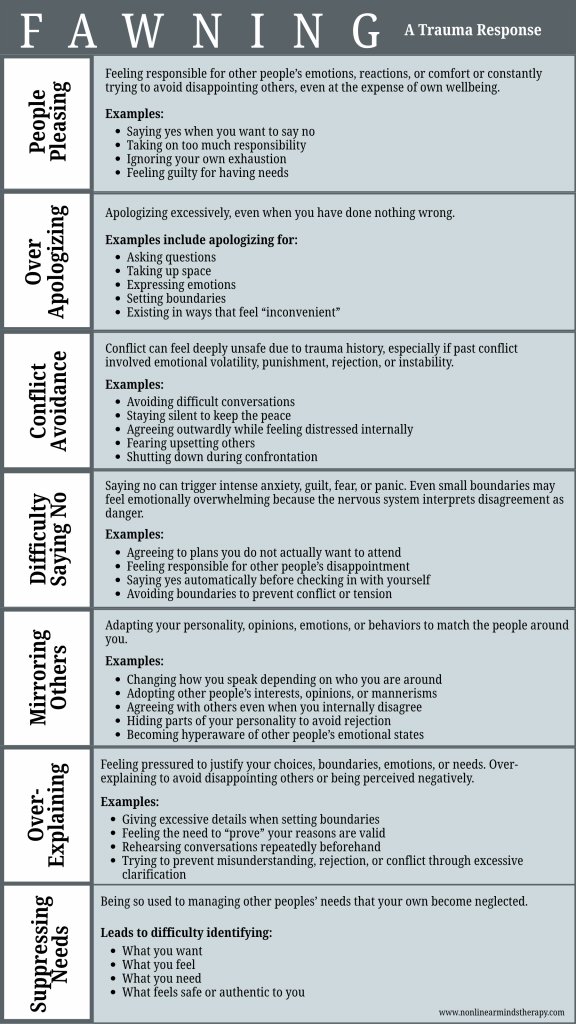
What Does Fawning Look Like?
Fawning can show up differently from person to person, but many people notice patterns like chronic people pleasing, overexplaining, emotional suppression, and difficulty setting boundaries.
Some common signs of the fawn trauma response include:
- People pleasing
- Over-apologizing
- Conflict avoidance
- Difficulty saying no
- Mirroring others
- Over-explaining
- Suppressing needs
Why Does Trauma Lead to Fawning?
The fawn response often develops in environments where emotional safety felt inconsistent, unpredictable, or conditional.
This can happen in situations involving:
- Childhood trauma
- Emotional neglect
- Toxic family dynamics
- Chronic criticism
- Abuse
- Unpredictable caregivers
- High-conflict environments
- Relationship trauma
When someone grows up in an unsafe or emotionally unstable environment, the nervous system constantly scans for ways to reduce threat. For some, becoming hyper-attuned to others becomes the safest option. It becomes a survival skill.
This is especially common in environments where expressing needs led to punishment, caregivers were emotionally unavailable, love felt conditional, emotional caretaking was expected, or where conflict escalated unpredictably. Over time, the nervous system becomes conditioned to prioritize external safety over internal needs.
This is not weakness. It is adaptation.
How do I Know if i’m Genuinely being kind or fawning?
Healthy kindness, or genuine care is a choice. Fawning is rooted in fear.
Genuine Kindness
- Intention
- Flexible
- Authentic
- Sustainable
- Connected to your values
Fawning
- Compulsive
- Anxiety-driven
- Draining
- Rooted in fear of rejection or conflict
- Difficult to stop, even when overwhelmed
A helpful question to ask yourself is:
“Would I still do this if I knew the other person might be disappointed in me?”
If the answer feels tied to fear, guilt, or emotional danger, the nervous system may be operating from a fawn response rather than authentic choice.
How Fawning Affects Mental Health
Living in a chronic state of people pleasing and self-suppression can have a significant impact on mental health and nervous system functioning.
Over time, fawning can contribute to:
- Burnout
- Chronic stress
- Anxiety
- Emotional overwhelm
- Resentment
- Identity confusion
- Low self-worth
- Relationship exhaustion
Many people who fawn also experience chronic nervous system dysregulation because their body rarely feels fully safe enough to relax. Fawning can also overlap with masking behaviors, particularly for neurodivergent individuals who have learned to hide parts of themselves in order to gain acceptance, reduce conflict, or avoid rejection.
Healing the Fawn Response
Healing the fawn response is not about becoming selfish, cold, or uncaring. It is about helping the nervous system learn that your needs, boundaries, emotions, and authenticity are safe too. Healing often involves:
Learning Boundaries
Boundaries can feel uncomfortable at first, especially if your nervous system associates them with danger or rejection.
Small steps matter:
- Pausing before automatically saying yes
- Giving yourself time to decide
- Practicing honest communication
- Allowing discomfort without immediately fixing it
Nervous System Regulation
Because fawning is connected to survival responses, healing often involves supporting nervous system regulation.
This may include:
- Grounding exercises
- Somatic therapy
- Mindfulness
- Breathwork
- Rest
- Safe connection
- Reducing chronic overstimulation
Recognizing Your Own Needs
Many people who fawn have spent years focused outward. Healing includes learning how to identify your own emotions, your limits, your values, and your identify outside of caretaking. It can feel overwhelming to put the focus on yourself at first. It’s okay if you don’t know the answers right away. Be gentle with yourself.
Tolerating Discomfort
One of the hardest parts of healing is learning that other people’s disappointment does not automatically mean you are unsafe.
This can take time.
The nervous system may initially react strongly when boundaries are set, even healthy ones.
Therapy and Support
Trauma-informed therapy can help people better understand the roots of fawning, process attachment wounds, improve emotional safety, and build healthier relational patterns.
Healing is not about becoming less caring.
It is about learning that you deserve care too.
Want the bigger picture? Explore all guides ➜